7 Heat Transfer Theory and the Heat Conduction Equation
7.1 Heat Transfer Theory
Heat transfer occurs by conduction, convection, radiation, and so on. Heat conduction describes heat transfer within the interior of a substance, whereas convection and radiation occur at the boundary.
Conductive heat transfer basically occurs from high temperature to low temperature. If a thermal constitutive equation (i.e., a heat conduction law) that reflects this phenomenon is used, the second law of thermodynamics is naturally satisfied. Heat conduction has not only magnitude but also direction. That is, it is a vector quantity. It is therefore similar to the phenomenon of fluid flow. This vector quantity, that is, the heat conduction rate \(\mathbf{q}\), is called the heat flux. Therefore, the heat conduction law prescribes the relationship between the heat conduction rate and the temperature. The most widely used heat transfer law is Fourier's law of heat conduction, which is formulated as follows.
Here, \(k\) is the thermal conductivity, generally regarded as a function of position and temperature. Equation (7.1) means that the heat flux is linearly proportional to the temperature gradient and occurs in the direction opposite to the gradient, that is, from a location of high temperature to a location of low temperature.
Convective heat transfer occurs at the surface and is caused by the difference between the surface temperature and the ambient temperature and by the flow of the atmosphere. The most widely used convective heat transfer law is as follows, and this is called Newton's law of convective heat transfer.
Here, \(h\) is called the heat transfer coefficient, and \(T\) and \(T_\infty\) are the surface temperature of the material and the ambient temperature, respectively. \(\mathbf{n}\) is the outward unit normal vector defined at the boundary.
Radiative heat transfer is heat transfer that occurs, between the surface of a body and the atmosphere or between two radiating surfaces, due to the energy that a body radiates when the distribution of electrons within atoms or molecules changes. That is, the transfer of energy in the form of electromagnetic waves generated by a body is called radiative heat transfer. The amount of radiative heat that a body generates is proportional to the fourth power of the absolute temperature (Celsius temperature + 273.15). Therefore, the radiative heat transfer law between two bodies is as follows.
Here, \(\alpha\) is the Stefan-Boltzmann constant, \(\alpha = 5.6704 \times 10^{-8} \, \text{W}\text{m}^{-2}\text{K}^{-4}\). \(\varepsilon\) is the emissivity, which means the ratio of the emissivity of a body to that of a black body surface at the same temperature. The emissivity of a black body is 1.0, and its value differs according to the surface condition of the material. For example, aluminum foil is 0.03, whereas anodized aluminum is about 0.9. \(\mathbf{n}\) is the outward unit normal vector defined at the boundary.
7.2 The Heat Conduction Equation
In this section, index notation (see Appendix A) is followed for a concise expression of the equations. Also, equations used without special mention in this book follow index notation. The heat transfer phenomenon of a solid is formulated by the following heat conduction equation for a solid.
Here, \(T\) and \(t\) denote temperature and time, respectively, and \(k\) and \(\rho c\) denote the thermal conductivity and the heat capacity, respectively. \(Q\) is the heat generation rate, which consists of the heat generation rate due to deformation energy and the heat generation rate \(Q_0\) due to other heat sources. That is, the heat generation rate is expressed as
The heat generation ratio coefficient \(C_g\) means the proportion of the stress power \(\sigma_{ij} \dot{\varepsilon}_{ij}\) that is converted into heat. In general, it is known that about 90% (\(C_g = 0.9\)) of the stress power is converted into plastic heat, and the remainder is expended in the increase of internal energy, such as changes in the crystal structure of the material, residual deformation energy, and the increase of dislocations. In Equation (7.4), the first term is called the diffusion term. In heat transfer for a solid, the convective term, which reflects the rate of temperature change due to the flow of the material, is neglected.
Meanwhile, the boundary conditions are formulated as follows.
Here, \(n_i\) is the outward unit normal vector, and \(\bar{T}, T_c, T_w, T_e\) denote the prescribed temperature, the surface temperature of the contacting body, the temperature of the coolant, and the temperature of the surrounding environment, respectively, and \(h_c, h_q, h_e\) denote the heat transfer coefficient of the contact surface, the convective heat transfer coefficient with the coolant, and the convective heat transfer coefficient with the surrounding environment, respectively. \(\sigma \varepsilon\) is the product of the Stefan-Boltzmann constant and the emissivity of the body. \(q_f\) denotes the heat generation rate occurring at the contact surface due to friction, and is as follows.
Here, \(v_t\) and \(\bar{v}_t\) are the tangential velocity components of the workpiece and the die, respectively, and \(\sigma_t\) is the tangential stress of the contact surface. \(C_f\) is a constant with a value between \(0.0\) and \(0.5\), intended to account for the frictional heat at the boundary surface.
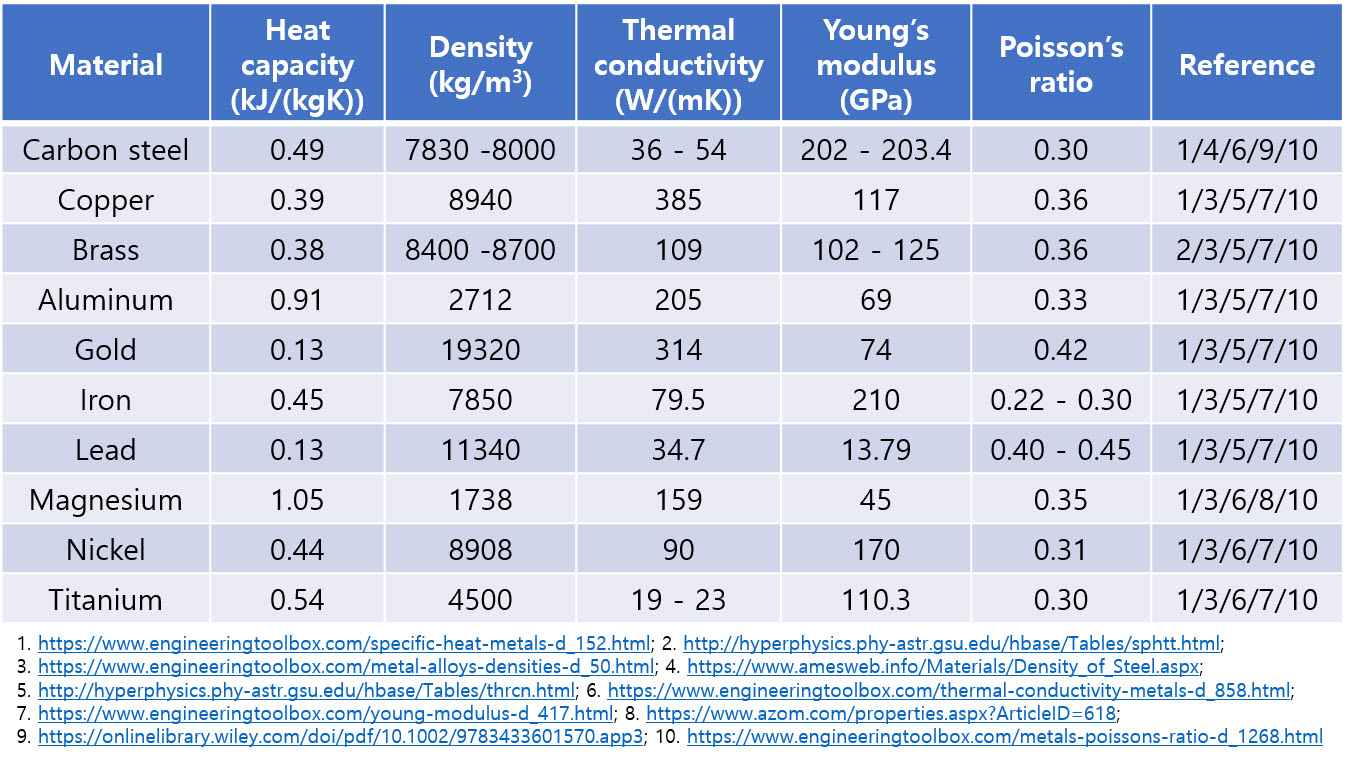
Table 7-1 summarizes the thermal information of major commercial materials together with basic information.